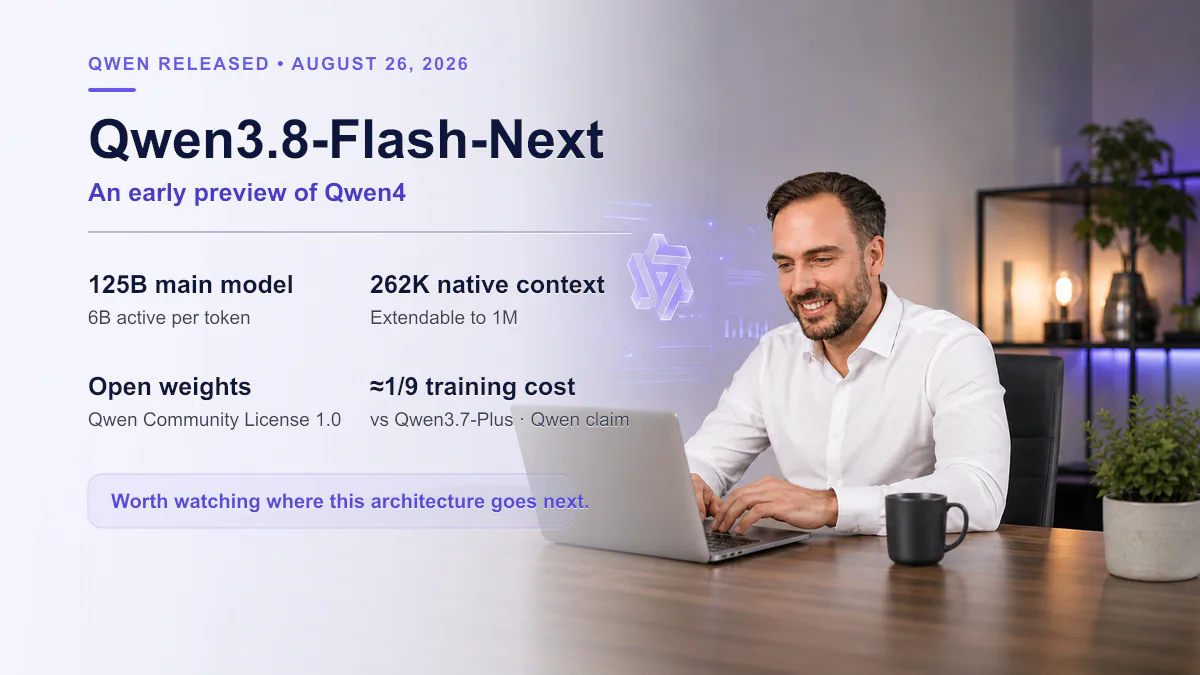
Qwen released Qwen3.8-Flash-Next on August 26.
The interesting part for me is not simply that another large model has arrived. Qwen describes this release as an early preview of the architecture it is developing for Qwen4. The team is opening the design early so the community can evaluate it before the full Qwen4 family is built on top of it.
What Actually Shipped
According to the official Qwen announcement, Qwen3.8-Flash-Next is a multimodal mixture-of-experts model with a 125B-parameter main model and another 51B parameters in its n-gram embeddings.
Only 6B parameters are activated for each token. That is the number that matters for the model’s per-token compute—not the much larger total capacity sitting behind it.
The model natively supports 262,144 tokens of context and can be extended to one million tokens with YaRN. That distinction matters: one million is the extended configuration, not the native context window.
The Qwen4 Preview Is the Real Story
Qwen is changing four parts of the architecture at once:
- Gated DeltaNet and Qwen Sparse Attention for cheaper long-context memory and retrieval
- Gated Residual branches for stronger information flow between layers
- N-gram embeddings for extra capacity with little per-token computation
- A refined Muon optimization recipe for more efficient and stable training
Qwen also claims training takes about one-ninth as much as Qwen3.7-Plus while improving coding and office-task performance. That is a vendor claim, and independent testing will matter, but a cost reduction of that size is still worth paying attention to.
Open Weights, With Conditions
The weights are available through the official model repository and Hugging Face. They use Qwen Community License 1.0, which includes conditions for some large commercial products, model-as-a-service businesses, and commercial AI work assistants.
So I would call this an open-weight release rather than unrestricted open source.
For now, Qwen3.8-Flash-Next is a preview, not Qwen4 itself. But 6B active parameters, long context, and radically lower claimed training cost make this architecture worth watching.